Personalized movie summarization using deep cnn-assisted facial expression recognition
Ijaz Ul Haq , Amin Ullah , Khan Muhammad , Mi Young Lee and Sung Wook Baik
Complexity, 2019
Automatic movie summaries are one-size-fits-all, which is the wrong shape for a subjective medium. This system lets a viewer ask for a summary by emotion — show me the happy moments — by segmenting the film into shots, keeping only visually salient ones with clear faces, and classifying each character’s expression into one of seven emotions. The trick that makes it work is a two-step transfer: train ResNet-50 from scratch on face data first, then fine-tune for expression, lifting KDEF accuracy from 64.8% to 93.7%.
Problem and motivation
Movie summarization compresses a feature film into the scenes that matter. The established approaches are automatic — fusing motion, contrast, rhythm, character social networks, scripts or subtitles into one canonical summary — and user-preference based, which let the viewer steer.
The paper’s argument against automatic summarization is not that it works badly but that the target is ill-posed. Movie taste is subjective, so a single summary that satisfies one viewer will fail another. There is no correct answer to compute.
What is missing is a control the viewer actually cares about. Prior user-preference systems let people set summary duration, or compared user preferences against movie content at the feature level rather than the semantic level. This paper picks emotion as the semantic handle: emotional moments are what draw an audience’s attention, so letting a viewer request them directly is both meaningful and easy to express.
How the method works
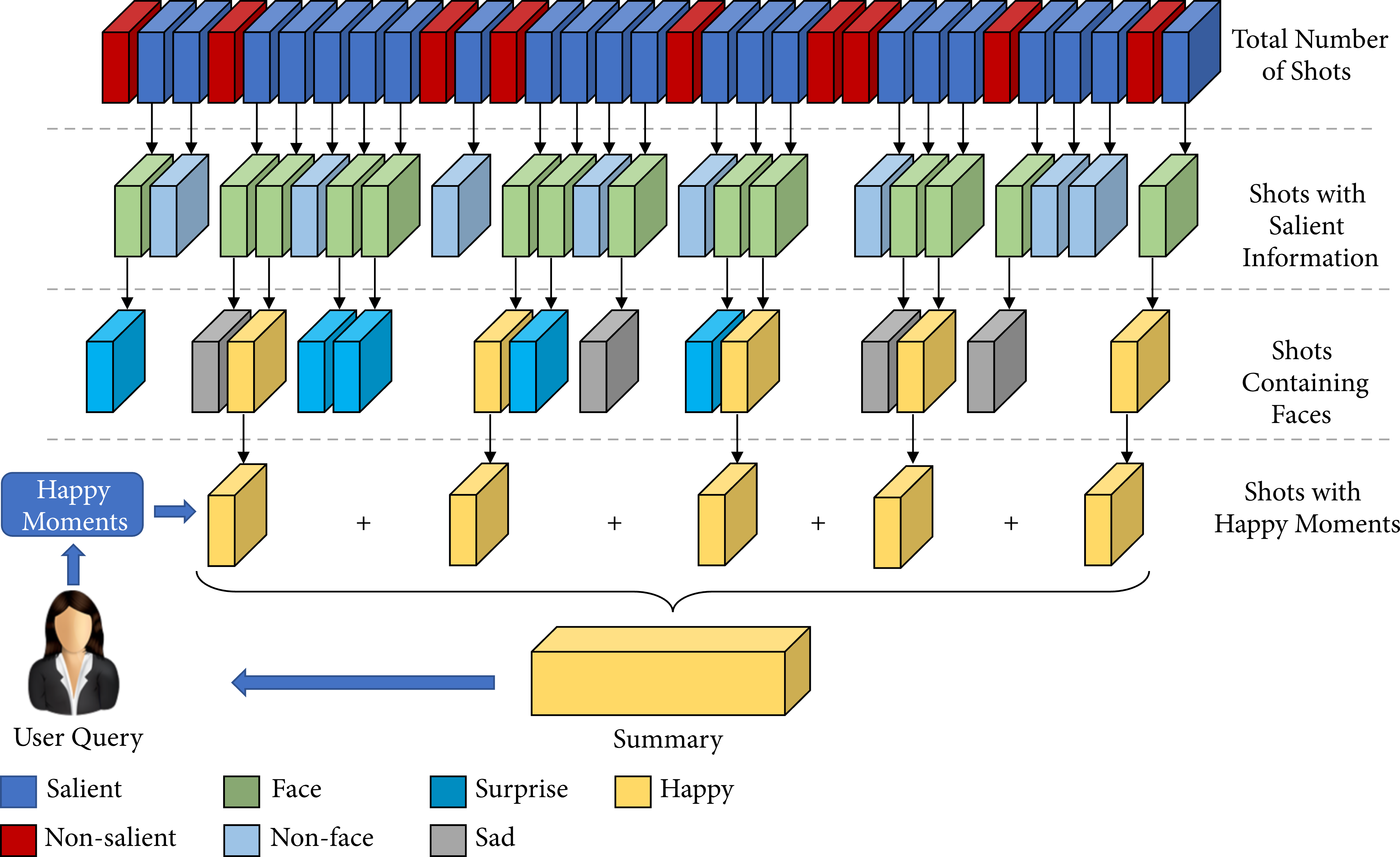
1. Entropy-based shot segmentation. Films are structured video — scenes made of shots, each an uninterrupted camera segment. The paper segments by computing per-frame Shannon entropy over the pixel intensity distribution and cutting where visual content changes sharply. Entropy doubles as an information measure, so the same computation separates informative shots from uninformative ones.
2. Saliency filtering. Each frame’s saliency map is reduced to a score — nonzero saliency pixels over total pixels — and averaged across the shot. Shots below a threshold are dropped before any expensive processing happens.
3. Face detection with a size constraint. A multi-task cascaded network detects faces in the surviving shots, keeping only faces occupying at least 15% of the frame. This has two justifications: main characters are filmed in close-up, and expression recognition is unreliable on small faces.
4. Facial expression recognition. Each shot’s faces are classified into seven emotions. Because a single frame is a poor proxy for a whole shot, and shots may contain several faces, the most frequently detected emotion becomes the shot’s label.
5. Summary generation. The user submits an emotion query; shots labelled with that emotion are concatenated into the summary.
The two-step transfer learning result
This is the part of the paper with the clearest lesson. Fine-tuning ImageNet-pretrained models on the KDEF expression dataset does not work well — the reported accuracies are 40.7% for MobileNet, 45.4% for SqueezeNet, 46.8% for AlexNet, 52.6% for GoogLeNet and 64.8% for ResNet-50. The diagnosis: expression recognition depends on very small changes within a face, and a model whose features were shaped by 1,000 generic object categories has not learned to represent faces at all.
The fix is to insert an intermediate task. ResNet-50 is reconfigured for 128x128 inputs (the original 224x224 kernel, stride and padding settings do not transfer) and trained from scratch on the VGG-Face dataset — 0.42M training and 0.14M validation images across 2,597 identities — for 50 epochs at batch size 64, learning rate 0.01 decayed tenfold every 10 epochs. That model reaches 96.82% face identification accuracy. Only then is it fine-tuned on KDEF, for 30 epochs starting at learning rate 0.001, reaching 93.65% overall.
The jump from 64.83% to 93.65% is attributable entirely to what the network was pretrained on, not to its architecture or capacity.
Evaluation
Objective. Per-class accuracy on KDEF is above 90% for disgust (96.1%), happy (98.0%), neutral (93.3%) and surprise (97.7%), and below it for afraid (82.3%), angry (88.6%) and sad (87.7%) — the three that are most easily confused with one another in the confusion matrix.
Subjective. Five Hollywood films across genres were summarised: The Lake House, My Blueberry Nights, You’ve Got Mail, Salt and Notting Hill. Ten participants aged 20-25 watched each film, then rated summaries generated from their own query on three questions — relevance to the query, enjoyability, and informativeness — on a 1-10 scale.
Results split cleanly by genre. Drama, comedy, romance and fantasy score well; Salt, the action film, scores worst, because fast motion blurs faces and makes expression recognition unreliable. Notting Hill scores best, being emotionally rich. The emotion statistics tell the same story from another angle: across all five films, neutral dominates, and Salt yields only 4 happy shots against 72 sad and 102 neutral.
Key contributions
- Framed movie summarization as an emotion query, letting the viewer request the emotional register they want rather than accepting one automatically-chosen summary.
- Introduced an entropy-based shot segmentation that simultaneously cuts shots and rates how informative they are, so uninformative shots are excluded before further processing.
- Showed that a two-step transfer — scratch training on face identity, then fine-tuning for expression — outperforms ImageNet-pretrained fine-tuning by nearly 29 accuracy points on KDEF.
- Adapted ResNet-50 to 128x128 face inputs rather than reusing 224x224 pretrained weights whose kernel, stride and padding settings do not fit the smaller image.
Datasets
- VGG-Face — 2.6M images of ~2.6K celebrities; filtered to 0.42M training and 0.14M validation images over 2,597 identities for the scratch-training stage.
- KDEF (Karolinska Directed Emotional Faces) — 4,900 images of 70 subjects (35 male, 35 female) across seven emotion classes, shot from five angles in two sessions — the pose variety is what makes it transfer to movie footage.
- Five Hollywood films — The Lake House (105 min, 865 shots), My Blueberry Nights (90 min, 1,009 shots), You've Got Mail (119 min, 1,049 shots), Salt (100 min, 2,339 shots), Notting Hill (124 min, 1,623 shots).
Results
| Model | Pretraining | KDEF accuracy |
|---|---|---|
| MobileNet | ImageNet | 40.65% |
| SqueezeNet | ImageNet | 45.37% |
| AlexNet | ImageNet | 46.81% |
| GoogLeNet | ImageNet | 52.63% |
| ResNet-50 (224x224) | ImageNet | 64.83% |
| ResNet-50 (128x128) | VGG-Face, from scratch | 93.65% |
Expression recognition accuracy on KDEF when fine-tuning different pretrained models, showing the effect of pretraining on face data rather than ImageNet.
Limitations and open questions
- Performance degrades on action films. Fast motion blurs faces, so both detection and expression recognition suffer — Salt is the clear outlier in the subjective study.
- The system is visual only. Dialogue, score and sound design carry much of a film’s emotional signal and are ignored; fusing aural features is named as future work.
- Neutral dominates the detected emotion distribution in every test film, so summaries for rarer emotions such as disgust or surprise are assembled from very few shots.
- Subjective evaluation used ten participants in a narrow age band (20-25), which is a small and unrepresentative sample for a claim about user satisfaction.
- Emotion is read from the character’s face only, not from the emotional effect on the viewer, so a tense scene with impassive characters will not be selected.
Related work on this site
Resources
BibTeX
@article{ul2019personalized,
  title={Personalized movie summarization using deep cnn-assisted facial expression recognition},
  author={Ul Haq, Ijaz and Ullah, Amin and Muhammad, Khan and Lee, Mi Young and Baik, Sung Wook},
  journal={Complexity},
  volume={2019},
  pages={1--10},
  year={2019},
  publisher={Hindawi Limited},
  dimensions={true},
  doi = {10.1155/2019/3581419},
}