Densely deformable efficient salient object detection network
Tanveer Hussain , Saeed Anwar , Amin Ullah , Khan Muhammad and Sung Wook Baik
arXiv preprint arXiv:2102.06407, 2021
Most strong salient-object-detection models lean on a depth channel alongside RGB, which doubles the compute and breaks down when the depth map is noisy. DDNet drops depth entirely and instead uses densely connected deformable convolutions, which adapt their sampling grid to the geometry of the object. With 3.3M parameters it sets the best E-measure and MAE on the SIP benchmark against 22 competing methods. The paper’s more interesting result is negative: a purpose-built cross-dataset shows every current model, DDNet included, generalises poorly.
Problem and motivation
Salient object detection asks a model to highlight what a human eye would look at first. The field’s recent gains have largely come from RGB-D methods, which pair the colour image with a depth map and fuse the two streams — at input, early, late, or at several stages.
That progress carries two costs. Two-stream fusion architectures are computationally expensive, which limits where they can be deployed. And they inherit the depth sensor’s failure modes: when the depth image is noisy or the scene is heavily occluded, RGB-D methods degrade noticeably. Meanwhile RGB-only methods have historically struggled when the object shares texture and colour statistics with a cluttered background.
There is a third problem the paper treats as its real target. Benchmarks evaluate on a test split drawn from the same dataset as training, which measures interpolation, not robustness. For a surveillance deployment — where lighting, distance and occlusion all shift — that number is close to meaningless.
Key idea
Standard convolution kernels sample the input on a fixed rectangular grid, so they model geometric transformations (pose, scale, viewpoint) only by memorising many augmented examples. Deformable convolutions learn per-location offsets to that sampling grid, letting the receptive field bend around the actual shape of the object. The paper’s bet is that this is exactly what separates foreground from background under the transformations that break RGB-only SOD.
The twist is densely deformable: rather than stacking deformable layers in sequence, DDNet wires three of them with dense connections. The ablation is direct — three plain deformable convolutions produce coarse maps with rough edges; densely connecting them gives the best result in the paper. Deformable layers are expensive relative to regular ones, so the design deliberately uses only three of them rather than making the whole network deformable.
How the method works
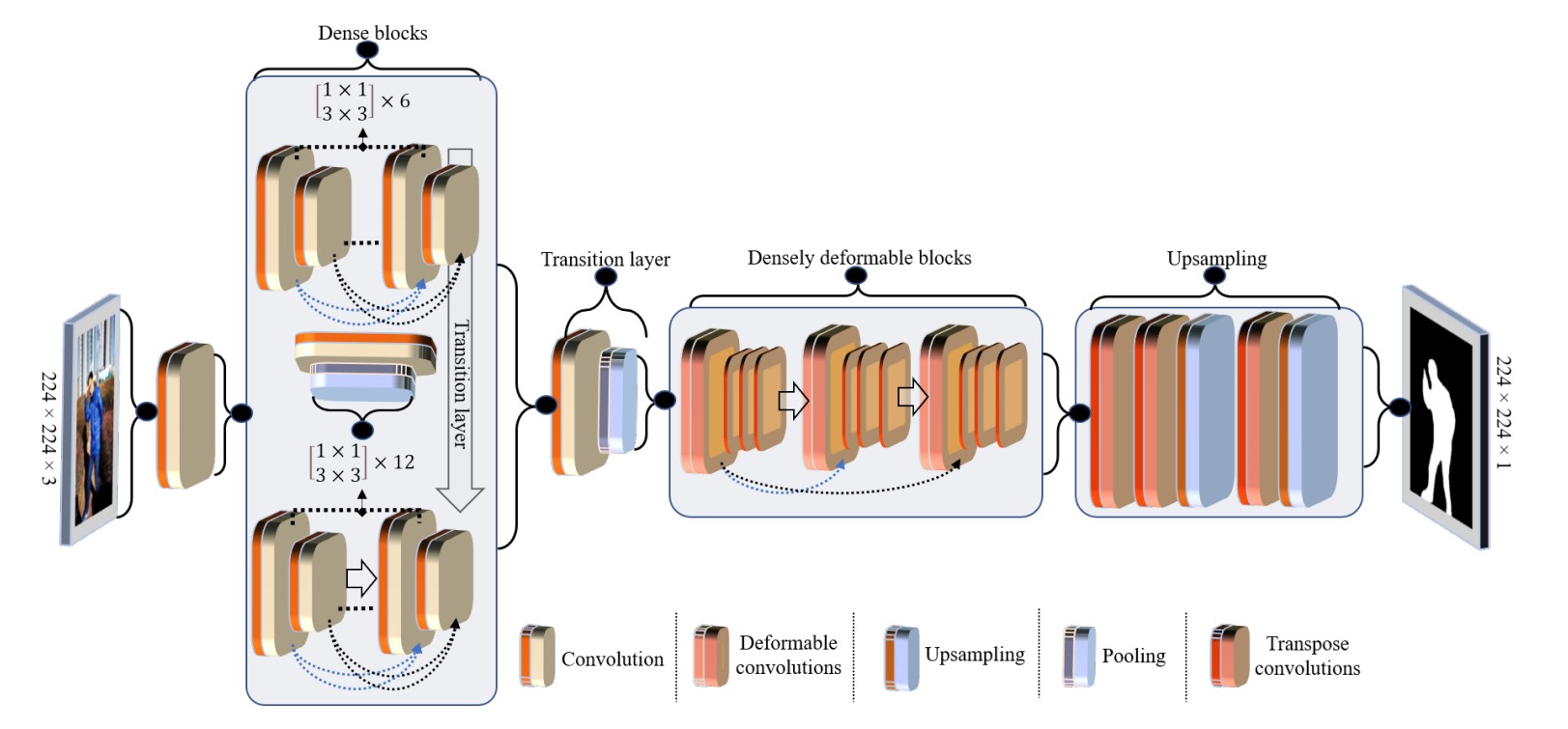
DDNet has three blocks.
1. Dense feature blocks. Two densely populated blocks, inspired by DenseNet, extract low-level edge and shape features. Each contains 1x1 and 3x3 convolutions with max-pooling and batch normalisation between them; a transition layer with a single 1x1 convolution and stride-2 average pooling reduces resolution before the second block, which uses 12 convolutional layers per kernel size. Dilated and grouped convolutions were tried here first and did not extract fine enough detail.
2. Densely deformable block. Three deformable convolutions with dense interconnections refine the salient regions and their boundaries.
3. Transpose convolution decoder. Three transpose convolutions and two upsampling layers bring the map back to input resolution as a single-channel saliency image. Bilinear interpolation in the transpose convolutions performs the edge smoothing that methods relying on plain upsampling skip.
Training used ADAM at a base learning rate of 1e-4, MSE loss, batch size 16, 500 epochs, and 224x224 inputs — about three hours on one RTX 2070 SUPER. Dense blocks were initialised from ImageNet-pretrained DenseNet weights.
The generalization result
To test robustness properly the authors built S-SOD, a small cross-dataset of 70 high-resolution surveillance images at 512x512, most drawn from the Chokepoint dataset and the rest captured by the authors. It targets the cases benchmarks avoid: subjects far from the camera, multiple occluded people, strong lighting variation, varied poses and distances. Masks were annotated in MATLAB by an unbiased annotator and checked by two computer vision experts.
The results are sobering. On SIP, DDNet reaches 0.935 E-measure and 0.043 MAE. On S-SOD the same model scores 0.595 E-measure and 0.108 MAE, and every baseline collapses further — ENet reaches 0.254 E-measure with 0.900 MAE. The paper’s conclusion is that current SOD models, including its own, have limited generalization potential, and that this deserves more attention than another point of benchmark accuracy.
Ablations
Two ablation axes are reported. On backbone: EfficientNet is cheapest but produces saliency maps that match ground truth poorly; VGG16’s first two convolutional blocks are the strongest alternative (0.916 E-measure); densely connected convolutions still win overall. On loss: MSE is used in the final model, with BCE and an SSIM-negation loss both substantially worse — SSIM in particular collapses to 0.506 E-measure on VGG16.
Removing the dense deformable connections (DDNet w/o DD) costs 1.8 points of E-measure and raises MAE from 0.043 to 0.050 at identical parameter count, which is the cleanest evidence for the paper’s central claim.
Key contributions
- Showed that densely connected deformable convolutions can match or beat RGB-D methods on salient object detection while using only the RGB channel.
- Achieved the best E-measure (0.935) and lowest MAE (0.043) on SIP against 22 competing methods, with 3.3M parameters and 35-47ms per image.
- Built and released S-SOD, a surveillance cross-dataset designed specifically to measure generalization rather than in-distribution accuracy.
- Documented that all evaluated models — including DDNet — degrade sharply on S-SOD, framing cross-dataset generalization as the open problem in the field.
Datasets
- SIP (Salient Person) — 929 challenging images with ground-truth masks and depth maps; standard training/testing split followed for comparison against 22 methods. DDNet ignores the depth channel.
- S-SOD (Surveillance SOD) — introduced here — 70 high-resolution 512x512 surveillance images with expert-verified binary masks, built as a cross-dataset test of generalization. Mostly sourced from Chokepoint plus author-captured images.
Results
| Dataset | Model | E-measure | S-measure | F-measure | MAE |
|---|---|---|---|---|---|
| SIP | UCNet | 0.927 | 0.883 | 0.877 | 0.045 |
| SIP | DDNet (w/o dense deformable) | 0.917 | 0.844 | 0.785 | 0.050 |
| SIP | DDNet (full) | 0.935 | 0.863 | 0.813 | 0.043 |
| S-SOD | ENet (BCE) | 0.254 | 0.061 | 0.087 | 0.900 |
| S-SOD | VGG16 (w/ smoothing) | 0.478 | 0.305 | 0.112 | 0.402 |
| S-SOD | DDNet (dilated) | 0.576 | 0.501 | 0.167 | 0.085 |
| S-SOD | DDNet (full) | 0.595 | 0.488 | 0.176 | 0.108 |
Performance on SIP (higher is better except MAE) and the same models on the S-SOD cross-dataset. The gap between the two tables is the paper's main finding.
Limitations and open questions
- DDNet wins on E-measure and MAE but not on S-measure or F-measure, where some RGB-D methods remain ahead. The paper’s argument is efficiency and single-modality input, not a clean sweep.
- Generalization remains poor in absolute terms. Scoring 0.595 E-measure on S-SOD after 0.935 on SIP means the model is not deployable on unseen surveillance footage as-is.
- S-SOD has only 70 images, which the authors acknowledge — it diagnoses the problem rather than providing enough data to train against it.
- Stacking more deformable layers would likely improve representation but was ruled out on efficiency grounds, so the accuracy ceiling of the approach is untested.
Related work on this site
Resources
BibTeX
@article{hussain2021densely,
  title={Densely deformable efficient salient object detection network},
  author={Hussain, Tanveer and Anwar, Saeed and Ullah, Amin and Muhammad, Khan and Baik, Sung Wook},
  journal={arXiv preprint arXiv:2102.06407},
  year={2021},
  dimensions={true},
  doi = {2102.06407},
}