Deep learning for safe autonomous driving: Current challenges and future directions
Khan Muhammad , Amin Ullah , Jaime Lloret , Javier Del Ser and Victor Hugo C de Albuquerque
IEEE Transactions on Intelligent Transportation Systems, 2021
A survey of deep learning for the seven perception tasks that autonomous driving safety rests on, organised around a measurement-analysis-execution pipeline. Its value is less the taxonomy than the numbers it collects: pedestrian detection reaches 74% mAP in hard conditions, drowsiness detection tops out at 75.6% where humans manage 80%, and the best traffic-light detector on the VIVA dataset achieves 44% IoU. The paper’s blunt conclusion is that none of the reviewed methods handles measurement, analysis and execution together, and that all of them assume high-spec GPUs or cloud servers.
Why the survey exists
The safety case for autonomous driving is a numbers argument. In the USA alone there are roughly 6 million car accidents a year, injuring around 3 million people, with more than 90 deaths a day. Alcohol accounts for about 40%, speeding 30%, reckless driving 33%, and distracted driving kills more than 9 people daily. These are all failure modes of human attention.
Existing surveys covered planning and control, traffic light recognition, and vehicle localisation separately, along with the general role of deep learning in intelligent transport systems. What was missing was a focused study of deep learning for safety specifically — which is the backbone of any autonomous driving argument.
The survey structures the field around seven tasks: road detection, lane detection, vehicle detection, pedestrian detection, drowsiness detection, collision avoidance and traffic sign detection. These map onto a three-stage measurement-analysis-execution pipeline: sensors and cameras gather data (M), filtering and tracking algorithms process it (A), and actuators trigger an alarm or take control — automatic braking, for instance (E).
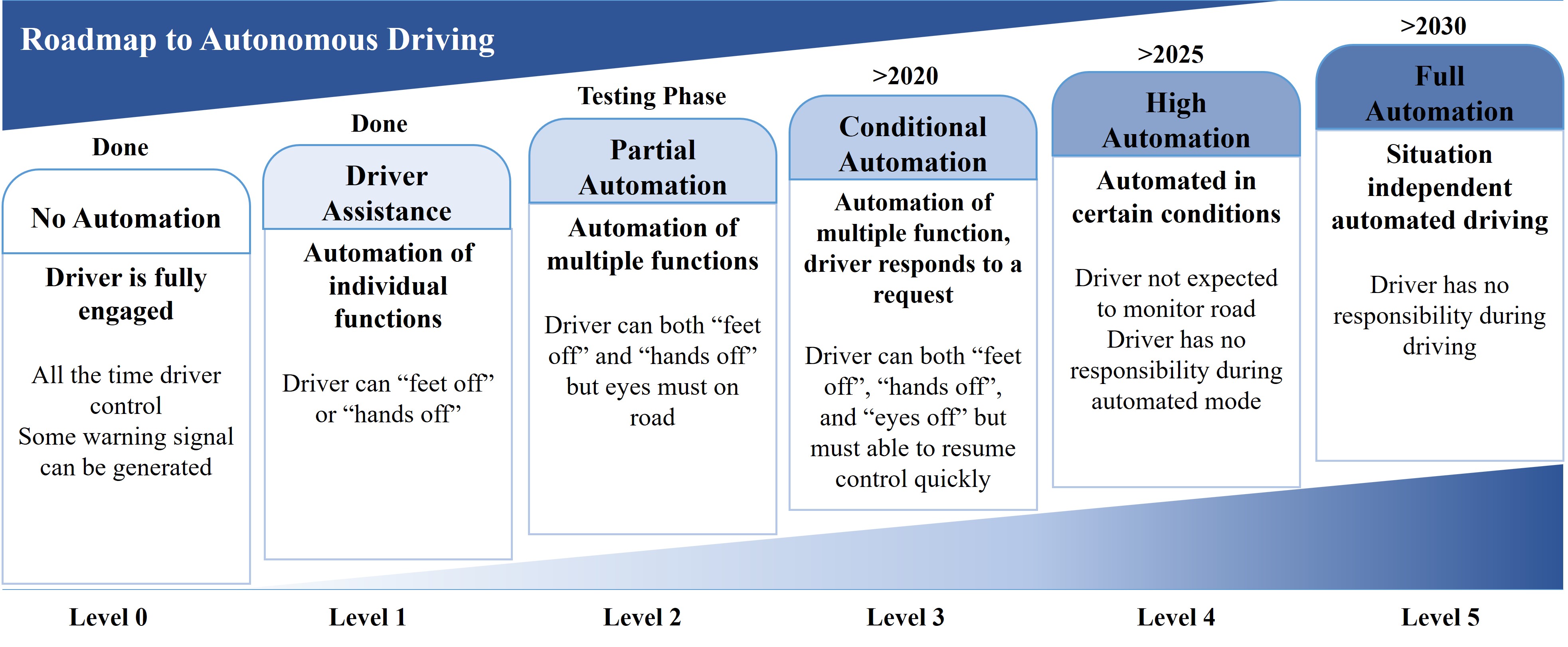
The SAE automation levels give the other axis. Level 0 is full human control; Level 2 (Tesla Autopilot, Nissan ProPilot) keeps the car in lane but needs an alert driver; Level 3 (claimed by Audi’s A8 Traffic Jam Pilot) drives in certain conditions with the human on standby; Level 4 can act safely when a request for human intervention goes unanswered, though it is not recommended in uncertain weather; Level 5 is full autonomy.
What the numbers say
The survey’s empirical section is the most useful part, because it puts the current state of each task on a common footing.
Pedestrian detection (KITTI, mAP): F-PointNet leads with 87.81 easy / 77.25 moderate / 74.46 hard, using fused 2D and 3D CNNs. The overall state of the art sits around 85% easy, 70-80% moderate, and under 65% hard. The survey’s comment is direct — for safe driving this needs to reach human-level perception across all three, and it does not.
Vehicle detection (KITTI, AUC): 3DOP reaches 93.04 easy; SubCNN gets 88.64 moderate and 79.27 hard. The survey notes that multi-CNN methods like SubCNN are not suited to real-time processing, which limits their relevance regardless of accuracy.
Drowsiness detection (accuracy): the best result, FFA, is 75.57% — below the 80% average accuracy of a human judging the same thing across day and night conditions. AlexNet manages 65.85%, VGG-FaceNet 67.85%, LRCN 61.5%, FlowImageNet 62.99%, DDD-FFA 70.81%. The two best methods ensemble features from three CNNs, which lifts accuracy but triples processing time. AlexNet and VGG-FaceNet carry 60M and 138M parameters — impractical for in-vehicle real-time use.
Traffic sign detection (Swedish Traffic Sign Dataset, 19,236 images, 20 categories): results are strong. MR Features + VSSA reaches 99.18% precision and 94.42% recall; Mask R-CNN 97.5% / 96.7%.
Traffic light detection (VIVA, IoU) is the outlier and the most alarming result. YOLOv2 reaches 25%, YOLOv2-tiny 21%, YOLOv3 18%, YOLOv3-tiny 16%, SSD 10%, Faster R-CNN 12%. The best method, RTTLD, achieves 44% IoU. On a dataset of complex real scenes covering green, red and turn signals at short and long range across day and night, well-known detectors are performing poorly.
The ten challenges
The survey’s critical verdict on the reviewed literature: none of the methods handles measurement, analysis and execution together, they are computationally expensive, and they assume high-spec GPUs or cloud servers — a setting that ignores energy consumption and prediction latency, both of which are real constraints in a vehicle.
The ten open challenges:
- System complexity — AD is a chain of decisions where each output feeds the next, so an efficient motion planner may require an energy-intensive feedback controller, and simpler controllers demand more detailed planning. These metrics conflict and must be balanced on the fly.
- Road environment dynamicity — illuminated advertising, digitised streets and rising traffic volume all degrade detection, tracking and recognition accuracy.
- Big data and real-time processing — sensors, cameras and LIDAR generate high-resolution data continuously; processing it in real time under accuracy, power and cost constraints is unsolved.
- Intelligent data prioritisation — a vehicle cannot process everything it captures, so it needs a mechanism to filter what matters across varied environmental scenarios.
- Robustness and adaptability — most models are trained in one environment and fail across weather conditions; snow, rain and fog remain inherently hard.
- Sensor fusion for dynamic decision making — no single sensor reaches target accuracy, but fusion work has focused on accuracy over implementation feasibility.
- Fairness, accountability and transparency — decisions that affect human lives require explanation, and deep models are black boxes. XAI could expose learned knowledge, enable post-mortem analysis of incorrect decisions, and reveal bias from imbalanced training data.
- Online learning — a model trained for urban driving does not transfer to rural roads with different traffic rules, nor to newly built areas or changed climates.
- Adversarial attacks — printable stickers have been shown to make vehicle cameras misclassify traffic signs. Defence research is active but has not been reconciled with design specifications and admissible risk limits.
- Traffic sign variability — detectors are trained at fixed input resolution, so resizing high-resolution images makes small signs undetectable. At 100 km/h, camera motion destroys the structure of small sign boards entirely.
Recommended directions
Eight directions are proposed:
- Energy-friendly CNNs — current architectures’ memory and compute demands limit their usefulness in-vehicle.
- Reinforcement learning — RL learns near-optimal control and path-planning policies, but almost all results come from simulators or restricted trials due to regulatory limits and prototype availability. Models trained offline in virtual environments cannot be deployed directly. Meta-reinforcement learning and higher-realism simulation (procedural urban scenario generation, data augmentation imprinting weather onto real driving data) are the suggested routes.
- Sequence learning and GANs — pedestrian activity cannot be read from a single frame. GANs could re-render scenes from new viewpoints to build richer RL training environments.
- Reliable, efficient motion planners and feedback controllers — balancing computational burden, speed and safety.
- Universal benchmark datasets — KITTI and others evaluate individual aspects; nothing measures the performance of a whole AD prototype.
- Industrialisation and personalisation — letting users adjust safety, speed and feature preferences.
- Edge computing — the standard train-centrally-then-deploy pattern fails when vehicular data changes over time, so online training at the edge is needed.
- Privacy-aware knowledge sharing — federated learning lets manufacturers improve shared models by exchanging parameters rather than data, which matters because commercial stakeholders will not share driving data from their customer base.
Key contributions
- Organised deep learning for autonomous driving safety around seven concrete tasks mapped to a measurement-analysis-execution pipeline, rather than by algorithm family.
- Compiled comparative empirical results per task on common benchmarks (KITTI, STSD, VIVA), making the gap between the strongest and weakest areas directly visible.
- Identified ten open challenges including several that receive little attention elsewhere — explainability under regulatory constraints, adversarial stickers on traffic signs, and the resolution problem for small sign boards at speed.
- Argued that no reviewed method addresses measurement, analysis and execution jointly, and that the field’s reliance on high-spec GPUs and cloud servers is a substantive gap rather than an implementation detail.
Datasets
- KITTI — Used for road, lane, vehicle and pedestrian detection, with easy / moderate / hard scenarios. Easy means a bounding box of at least 40 pixels height with no occlusion; moderate and hard drop to 25 pixels with partial and heavy occlusion respectively.
- STSD (Swedish Traffic Sign Dataset) — 19,236 images across 20 traffic sign categories.
- VIVA — Traffic light detection in extremely complex scenes — green, red and turn signals at short and long range, across day and night with varied illumination.
Results
| Task | Benchmark | Metric | Best result | Note |
|---|---|---|---|---|
| Vehicle detection (easy) | KITTI | AUC | 93.04 (3DOP) | Not real-time |
| Vehicle detection (hard) | KITTI | AUC | 79.27 (SubCNN) | Multi-CNN, slow |
| Pedestrian detection (easy) | KITTI | mAP | 87.81 (F-PointNet) | 2D + 3D fusion |
| Pedestrian detection (hard) | KITTI | mAP | 74.46 (F-PointNet) | Field average under 65% |
| Traffic sign detection | STSD | Precision / recall | 99.18% / 94.42% | MR Features + VSSA |
| Drowsiness detection | — | Accuracy | 75.57% (FFA) | Humans average 80% |
| Traffic light detection | VIVA | IoU | 44% (RTTLD) | YOLOv3 reaches only 18% |
Best reported performance per safety task, as compiled by the survey. The metric differs by task; the pattern of where deep learning is and is not ready is the point.
Limitations and open questions
- As a survey it reports results as published by their authors, under differing protocols and hardware, so cross-method comparisons within a task are indicative rather than controlled.
- Coverage stops at the measurement-analysis-execution pipeline; planning, control, localisation and V2X communication are deferred to other surveys.
- Published in 2021 with references collected through 2020, so it predates the transformer-based perception and end-to-end driving models that followed.
- Several reported figures are read from normalised bar charts rather than tables, so precision varies between tasks.
Related work on this site
Resources
BibTeX
@article{muhammad2020deep,
  title={Deep learning for safe autonomous driving: Current challenges and future directions},
  author={Muhammad, Khan and Ullah, Amin and Lloret, Jaime and Del Ser, Javier and de Albuquerque, Victor Hugo C},
  journal={IEEE Transactions on Intelligent Transportation Systems},
  year={2021},
  volume={22},
  number={7},
  pages={4316-4336},
  publisher={IEEE},
  dimensions={true},
  doi = {10.1109/TITS.2020.3032227},
}