Conflux LSTMs network: A novel approach for multi-view action recognition
Amin Ullah , Khan Muhammad , Tanveer Hussain and Sung Wook Baik
Neurocomputing, 2021
Recognising an action from several synchronised cameras is harder than it sounds: each viewpoint sees a different, partly occluded version of the same event. This paper gives every camera its own stacked LSTM to learn what that view alone can tell you, then fuses the views with a correlation layer built from pairwise dot products. On Northwestern-UCLA it reaches 88.9% average accuracy against 84.2% for the best prior RGB method, using only RGB video — no depth, no skeletons.
Problem and motivation
Human action recognition from a single camera is a mature problem. The multi-view version is not, and the reasons are structural rather than incidental. When several cameras watch the same person, the appearance of an action changes drastically between viewpoints, whole body parts disappear behind occluders in some views but not others, and the performer’s scale differs from camera to camera. A model that simply pools features across views ends up averaging away exactly the evidence that distinguishes one action from another.
Prior multi-view work attacked this with attention modules, joint sparse representations with distribution adaptation, and multi-view dynamic images. The paper’s reading of that literature is that these representations are brittle under large viewpoint and scale changes, and that they tend to commit to one view’s appearance and motion evidence rather than weighing all views at once. A second gap is practical: methods that do model temporal structure well are usually expensive enough to rule out real-time surveillance use.
The paper deliberately restricts itself to RGB input. Depth and skeleton streams make the problem easier, but they require specific sensors; RGB cameras are what is already installed in the buildings and streets where this would be deployed.
Key idea
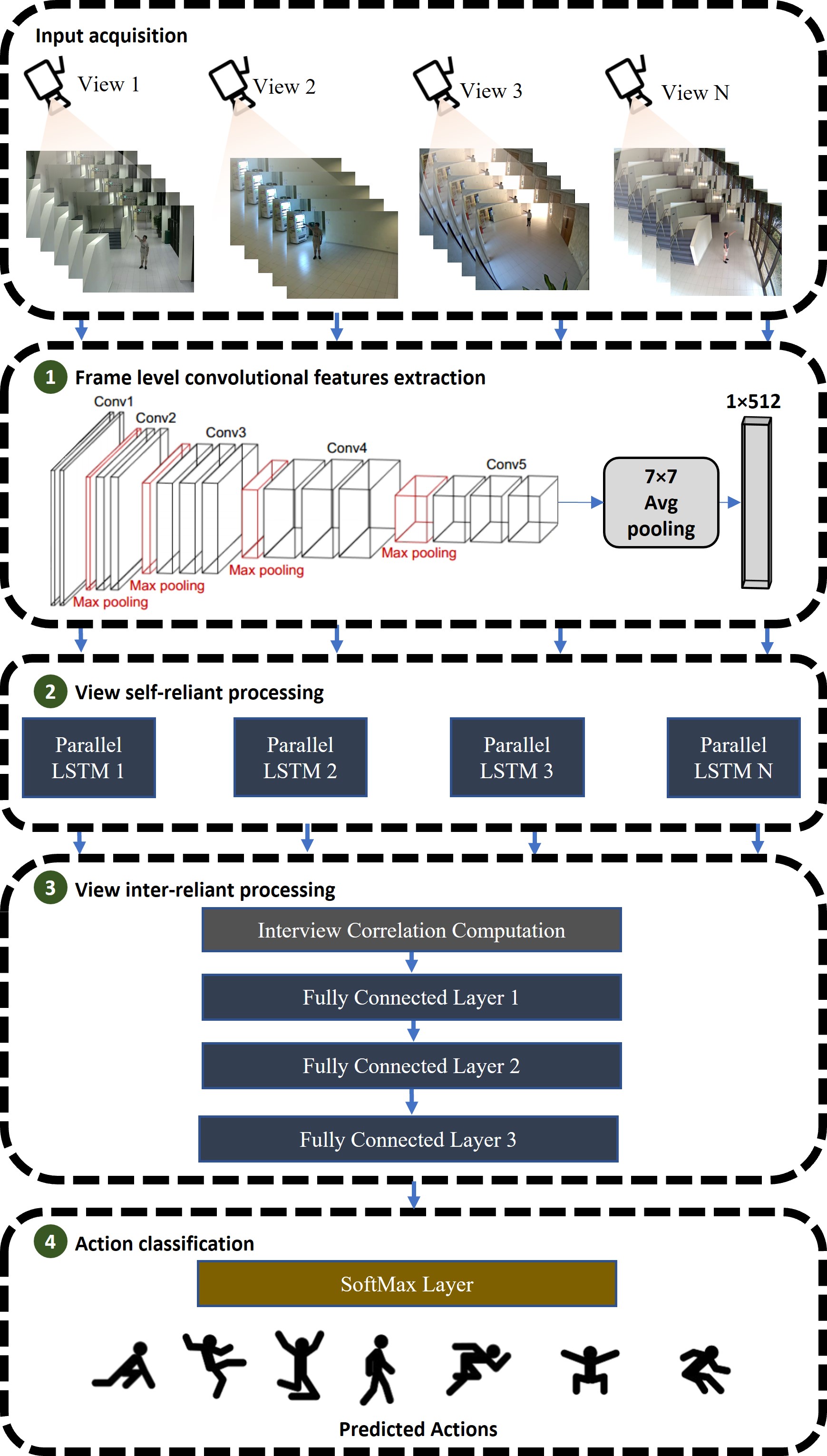
The architecture is named after the confluence of rivers: several independent streams that merge. Each camera view gets a dedicated stacked LSTM that never sees the other views during its own sequence modelling — the view self-reliant stage. Only after each stream has formed its own opinion about the temporal pattern in its own view are the streams merged, in a view inter-reliant stage that measures how the views agree.
The merge is not concatenation. Because the cameras have overlapping fields of view, their per-view sequence representations carry substantial redundancy and correlation, and the paper treats that correlation itself as the recognition signal. Borrowing the multiplicative patch comparison idea from FlowNet, the correlation layer takes pairwise dot products between feature points of the different views’ sequence outputs, convolving each stream against the other streams instead of against learned kernels.
How the method works
The pipeline has four stages.
1. Frame-level features. Each frame goes through a pre-trained VGG19. Rather than the fully connected layers, the paper taps the Conv5_4 convolutional layer. The argument is specific to video: fully connected activations encode global, slowly changing abstractions, so consecutive frames produce nearly identical vectors and the temporal signal is washed out. Convolutional kernels cover small receptive fields and therefore respond to exactly the local motion that distinguishes one frame from the next. Conv5_4 yields 7x7x512 feature maps; a 7x7 average pooling collapses each map to one value, producing a 512-dimensional vector per frame. With a sequence length of 15 frames, each view contributes a 7,680-dimensional sequence.
2. View self-reliant network. Each view drives a three-layer stacked LSTM with 256 memory cells, mapping 512 to 256 to 128 dimensions. Every view has its own copy of this stack, so a three-view setup has three parallel LSTM towers, each accounting for roughly 2.29M parameters. Bidirectional and deeper structures were considered and rejected on time-complexity grounds.
3. View inter-reliant network. The correlation layer compares feature points across the per-view sequences by pairwise dot product plus a bias, collapsing the multi-view sequences into a single one-dimensional representation.
4. Classification. Three fully connected layers of 128, 64 and 18 units follow the correlation layer, then a SoftMax classifier. The complete three-view network holds about 6.8M parameters. Network size and cost grow with the number of views, and the paper is explicit that accuracy also depends on how much the views overlap and how differently the performer is scaled across cameras.
Training setup
Implementation was TensorFlow 1.12 under Python 3.5 on Ubuntu 16.04, trained on a 12GB GeForce Titan X with an i5-6600 CPU and 16GB RAM. The learning rate started at 0.01 and dropped to 0.001 after 250 iterations, with stochastic optimisation for cost minimisation. Data was split 60% train / 20% validation / 20% test.
Two design choices were settled empirically. Sequence length was chosen as 15 frames after comparing 30, 25 and 15 on accuracy against runtime. LSTM cell size was chosen as 256 over 512, because with three stacked layers per view the larger cell size raised processing time steeply. The training curves also confirm the feature-layer argument: Conv5_4 features gave consistently higher validation accuracy than FC8 features.
Closed-set versus open-set evaluation
One of the more useful things about this paper’s evaluation is that it does not stop at the standard protocol. In the closed set, test clips are held out from the same views used for training. In the open set, the model is trained on some views and tested on views it has never seen — the situation that actually occurs when a camera is added or moved.
On Northwestern-UCLA the network scored 90.1% closed-set and 88.9% open-set; on MCAD, 80.3% closed-set and 86.9% open-set. The small open-set drop on Northwestern-UCLA comes mostly from confusion between walk around and carry. Class-wise, most categories clear 70%, with stand up, donning and doffing above 90%, while sit down falls to about 55% because it is systematically confused with stand up — unsurprising for two actions that are near time-reverses of each other.
Key contributions
- Identified Conv5_4 of a pre-trained VGG19 as the right frame representation for sequence learning, on the grounds that fully connected features change too little between consecutive frames to encode motion.
- Introduced the conflux structure — a separate stacked LSTM per camera view — so that each view’s self-reliant temporal pattern is learned before any cross-view mixing happens.
- Added a view inter-reliant correlation layer that fuses views by pairwise dot product rather than concatenation, turning inter-view redundancy into an explicit recognition cue.
- Evaluated under both closed-set and open-set protocols, reporting accuracy on views never seen during training rather than only on held-out clips from training views.
Datasets
- Northwestern-UCLA Multiview Action 3D — 3 synchronised Kinect cameras, 10 action categories, 10 subjects; RGB stream only (depth and skeleton data ignored). Shared background and visually similar categories make it hard.
- MCAD (Multi-Camera Action Dataset) — 5 cameras in a CCTV setup — 3 static fisheye at 1280x960 and 2 pan-tilt-zoom at 704x576 — with 18 actions by 20 subjects, repeated 4 times by day and 4 by evening. The moving, zooming cameras add viewpoint and scale variation.
Results
| Dataset | Method | Accuracy |
|---|---|---|
| Northwestern-UCLA | MST-AOG w/o Low-S | 65.3% |
| Northwestern-UCLA | MST-AOG w Low-S | 73.3% |
| Northwestern-UCLA | HOPC | 80.0% |
| Northwestern-UCLA | Multi-view dynamic images + CNN | 84.2% |
| Northwestern-UCLA | Conflux LSTMs network | 88.9% |
| MCAD | Cuboids | 56.8% |
| MCAD | Covariance matrices | 64.3% |
| MCAD | STIP | 81.7% |
| MCAD | IDT | 84.2% |
| MCAD | Conflux LSTMs network | 86.9% |
Overall recognition accuracy as reported in the paper's comparison tables (Tables 3 and 4).
Limitations and open questions
- The network is instantiated per view, so both parameter count and inference cost scale with the number of cameras — a three-view model is already 6.8M parameters before a fourth stream.
- It cannot run on a single view. The correlation layer needs at least two streams, which forced a modified protocol on Northwestern-UCLA (training on V1 and V2, testing on V2 and V3) rather than the single-view test protocol other methods use, so the comparison is not like-for-like.
- Accuracy depends on how much the camera fields of view overlap and on the scale of the performer in each view; the paper reports this as an observation rather than quantifying it.
- Feature extraction uses a frozen VGG19, which dominates the runtime. The authors name replacing it with a lightweight backbone as the main direction for making the system deployable on embedded hardware.
- Near-symmetric action pairs remain unsolved — sit down reaches only about 55% because it is confused with stand up.
Related work on this site
Resources
BibTeX
@article{ullah2021conflux,
  title={Conflux LSTMs network: A novel approach for multi-view action recognition},
  author={Ullah, Amin and Muhammad, Khan and Hussain, Tanveer and Baik, Sung Wook},
  journal={Neurocomputing},
  volume={435},
  pages={321--329},
  year={2021},
  publisher={Elsevier},
  dimensions={true},
  doi = {10.1016/j.neucom.2019.12.151},
}